Saturday, January 30, 2016

Budding Libraries Part 3: Labels, Labels, Labels

In earlier posts (see Budding Libraries Part 1 and Part 2), Michelle and I introduced and then provided an update about the status of our school libraries. In this newest update, we’re going to highlight the work that has been done recently – labels!

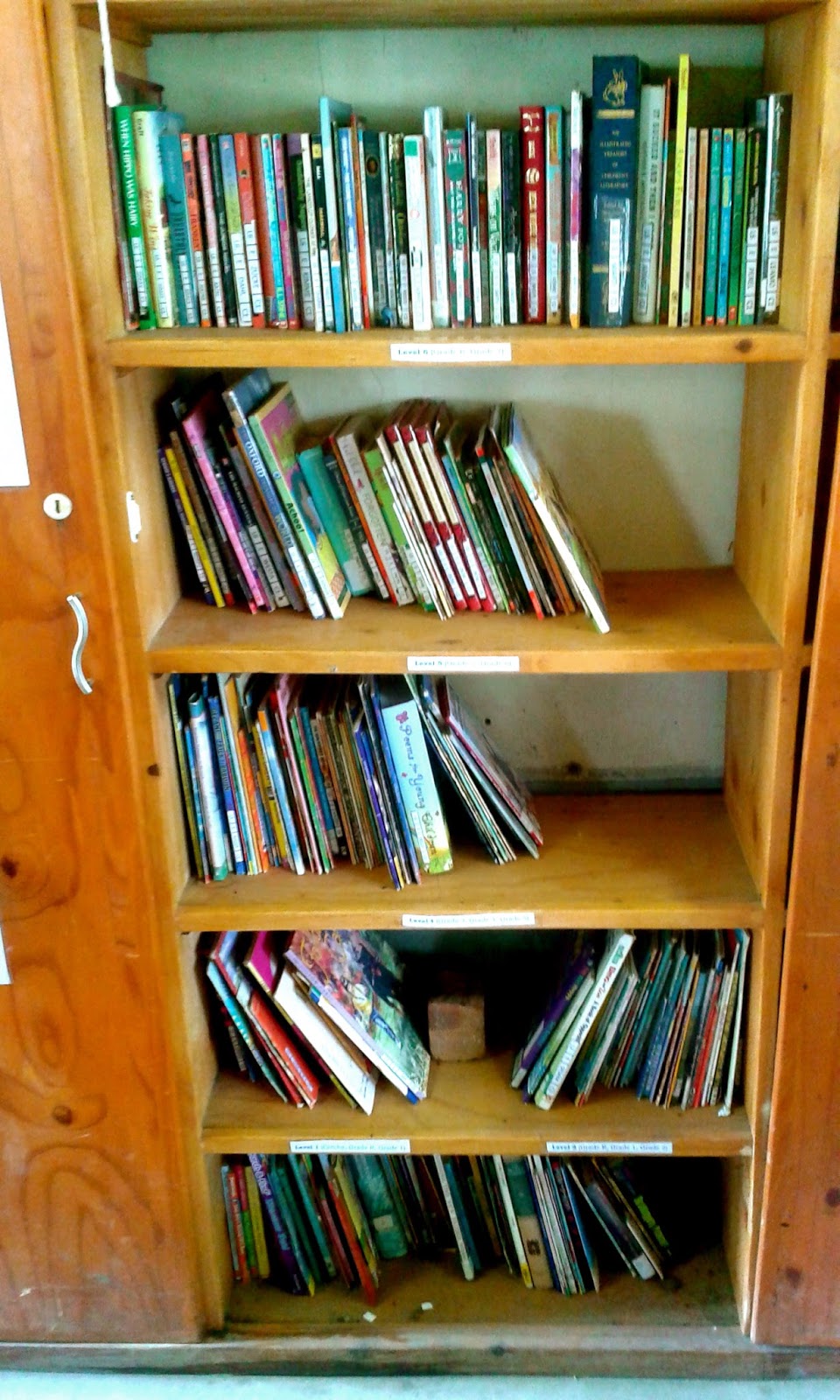
There's something about organization that feels so... good!
Don't the labels look pretty!

Our schools are brimming with books that are looking forward to having a home on the shelves in our libraries. Labeling them must come first however. While this is a fairly easy task to complete, with one exception, it is quite time-consuming. Here’s a run-through of what it takes to affix a label to a book:
  1. Grab a book and look at the cover, spine, and backcover to ensure the book is in intact
  2. Record the author’s name
  3. Make note of the language with which the book was written
  4. Here comes the hard part… determine the book’s reading level (we’ll explain reading levels more later)
  5. Type all of the above information into an Excel spreadsheet in shorthand to make the label
  6. Print the sheets
  7. Cut out the labels
  8. Tape the labels onto the books using packing tape
One of Joe's Colleagues Affixing Labels to Books
____________________________________________
A Quick Explanation of Reading Levels

Reading should be fun yet challenging for learners. In the pursuit of an appropriate book, a learner shouldn’t only read books that are too easy because then the learner won’t grow. Conversely, if a book is too hard for the learner, s/he could become discouraged and stop reading. Reading levels help with this. Using the font size, use of pictures, and number of words, sentences, or paragraphs on a page, reading levels can be assigned to the books. For example, a book with large font, lots of pictures, and very few words would fall into the lowest level. Meanwhile, a book with small font, no pictures, and consisting of over 100 pages would fall into the highest level. With reading levels assigned to the books, they can be grouped together to make it easier for a learner to find a book that’s appropriate for her/him.
____________________________________________

Several Books that Have Already Been Labeled in the Library at Joe's School
It takes about one hour to label roughly 60 books, if there aren’t any interruptions (i.e. learners asking a question, assisting other teachers, electricity shuts off). Luckily, there are a number of people at school who can offer a helping hand – learners and teachers!

One of Joe's Learners Cataloguing Books

A Couple of Joe's Learners Cataloguing Books

Michelle and I have been training learners and teachers how to catalogue, level, and label books. This has helped speed up the process. This has also helped teachers to see all of the fabulous resources we have and gain an appreciation for how much work goes into setting up the library and, thus, (theoretically at least) increase the likelihood that they will use these resources and work to maintain and build appreciation for the library in the long-haul.

A Few of Joe's Colleague's Cataloguing Books

One of Joe's Colleague's Cataloguing Books

As of January 2016, approximately 500 books have been labeled at each of our schools.

Now that teachers are back in the classroom fulltime because of the start of the new school year, we don’t have as many helping hands as we did, so the labeling has slowed down. It’s a good thing we have a few more months until our time with the Peace Corps comes to an end. Only about 1800 more books to go!

The Number of Labeled Books on the Shelves is Growing!

Thursday, January 28, 2016

Moneymoneymoneymoney, MONEY!

Like the classic O’ jays song, today’s post is all about the money. This is the newest prompt from the 2016 Blogging Abroad challenge. To catch up on our previous posts in this series, check then out: why am I abroad, a normal day in my life, views of a village, and my hero, Mama Maseko.


Show me the money! 

Source: http://cdn.smosh.com/sites/default/files/bloguploads/show-me-the-money.jpg
We wanted to highlight a few different ways to make 16 rand (or R16). With the current exchange rate, this is about equivalent to $1 in the US. So, what does $1 look like?

The easiest way to make R16 is: a R10 bill, a R5 coin, and a R1 coin.

R16 - the easy way!
The more complicated option… we’ve got two R5 coins, two R2 coins, one R1 coin, and two 50 cent pieces.

R5, R2, R1, and 50 cent coins
They also have 10 cent coins and 5 cent coins. However, almost no one will accept a 5 cent coin anymore, because…

FUN FACT! The 1 cent coin is obsolete in South Africa. This means if they ring up your bill at R24.57 (only it would be R24,57 because they use the comma instead of the period) and you pay in cash, they will only charge you R24,50. Woe if you pay with a credit card, you get stuck with the whole R0,07! #themoreyouknow

Price is Right: What can you get with $1?

We went to our nearby tuck shop (small convenience store) to explore some prices and show a few ways to make $1. The tuck shop is where we pick up odds and ends during the week. There are three grocery stores in town, where we do our bulk shopping on the weekends.

Our local tuck shop
First up, the “school lunch” combo: a loaf of bread (R11) and 5 bigga naks or nik naks, which are kind of like Cheetos (R1 each).

Bread and Cheetos
Add some spice in your life with a medium-sized bag of chips (R6) and a canister of Aromat, a salty spice which is put on everything (R10). Both are packed the flavour-enhancing monosodium glutamate. South Africa loves its MSG so much, you can just buy straight, powdered MSG in the grocery store. It is marketed as Zeal.

Aromat and Frimax
All of those salt and carbs making you thirsty? Reach for a nice, cold “cold drink” (R16). Cold drink is the blanket word for any kind of soda (or pop or Coke)…or anything you can find in a bottle that is not juice or water.

Cold drink
Serving tea with four slices of bread is a common way to greet and entertain new guests. Sometimes, though, you want to get fancy and grab a container of tea biscuits (small: R8; large: R16).

Tea biscuits
You can also buy some soap (R16).

Get clean!
Or self-rising flour (R16). You may be more interested in maize meal (its like a finer, white corn meal- R10). Joe swears by the cake wheat flour (R13). It makes your cookies super soft!

Beautiful flours!

What about produce?

In town, the sidewalks are filled with mamas selling vegetables and fruits. However, it can be difficult to purchase these in the village. Most families rely on what they grow in their own garden or exchange items with neighbours. Depending on what is in the season, the children crowd around the fruit trees. For example, every afternoon in November, kids will climb in our mango trees to knock out the fruit. In January, the izindoni trees (the fruit is purple and shaped like a teardrop, almost like a grape…I don’t know any English word for them) are all the rage. Now, we are starting to get into guava season.

All this money talk have you stressed?

You know what they say, "mo' money, mo' problems" (Notorious B.I.G.) Don’t worry. Remember life is so much more beautiful than what money can buy!


__________________________________

Still curious? 

Post a comment with any everyday item and we will reply with the current cost in rand. It will be like a fun scavenger hunt for us!

#TBT: Staff Outing on a Game Drive

*Note: this post is a throwback to an event that happened in December 2015.

As the school year draws to a close, my colleagues at school decided to go on a staff outing. They had been setting aside a portion of their paychecks since the beginning of the school year with the idea in mind that they would celebrate in some way before the school closed. My colleagues decided that they were going to go on a game drive. What was more, the teachers said the outing wouldn’t be complete if Michelle didn’t join us. I was excited about the prospect of doing something together as a staff.

Joe and Some of His Colleagues Seated in the Safari Truck
There’s a game park fairly close to our shopping town. It’s named after the local chief because his family donated the land. The park boasts many elephants along with a variety of other animals, including rhinos, zebras, leopards, and many more. It wasn’t until I was at the park waiting to get picked up by our safari truck that I learned lions were also at the park. My excitement heightened when I realized that there was a possibility we would get to see one.

A Herd of Impala Grazing

One of the Elephants with an Upraised Trunk

Rain threatened the forecast, but that didn’t dampen our spirits. It wasn’t long into the game drive that we saw a herd of impala and springbok. After a few more turns, the guide told us to get quiet because up ahead he spotted a herd of elephants. They were taking advantage of the rain to shower their bodies with dirt and sand. Fun fact: elephants splatter themselves with mud because it helps protect their skin from the sun and parasites. Ahhh… the irony of showering with mud during a rainshower – haha! We spent several minutes taking photos and gazing in wonder at the giant beauties.

Hey - watch where you throw that sand!

No big deal... just cruising behind a few elephants. :)

After the elephants sauntered away, we drove around a few more bends and came upon one of the watering holes located within the park. As we approached, Michelle whispered, “Look to your left. There, on the hill!” I couldn’t believe my eyes – on the hill stood two lions! Some of the other teachers had been to this game park once and twice before, but this was their first time to actually see the lions. There was much excitement in our truck. According to the guide, the lions were relatively young. I joked with Michelle, “If we call puppies pups as they age, and lions are called cubs when they’re babies, does that mean we can call these ones ‘pubs’?”

A Couple of Lions Seeking Shelter from the Rain

After the game drive, the rains cleared, which made for perfect timing because the staff and I were going to have a braai* next. I’m sure the carnivores of the game park were salivating as we grilled steaks, vorse*, and chicken. It was a good thing for us that we were safely separated by a sturdy, electrified fence. While the meat grilled on the braai, the teachers danced to tunes pulsating from one of the teacher’s cars. It was a fun site to see everyone, including the principal, get down.

What a Great Staff!
The staff outing is definitely one of my highlights of the school year. And with only one week until the school officially closes for the December break, I’m grateful that we were able to have that time together.

____________________________

*braai = barbeque
*vorse = sausage

Monday, January 25, 2016

Mama Maseko: My South African Hero

There are times in your life when you meet someone who brings you such faith and hope for humanity, the giddy joys of possibility, and the inspiration to do more. In my South African life, that woman is Ma’am (or often, Mama) Maseko.
Ma'am Maseko and I at Heritage Day 2014
I first knew that Ma’am Maseko was someone special when, while making conversation with educators at my school, more than one of them cited her as their inspiration for teaching. One said, “I knew I wanted to do something good with my life, but I didn’t know where to start. Ma’am Maseko convinced me to start volunteering at the school crèche to gain experience; I loved it so much I just kept teaching.” I made a mental note to get to know this influential person better.

Over the last year and a half, I continue to be inspired by this loving, thoughtful, and passionate friend and colleague. I wanted to honour her work and our friendship by telling a bit more about her and her story with you all.

To start, I want to provide just a snapshot of her work, both at home and in the community:
  • Full-time teacher in grade R (kindergarten) at my school
  • Works 3 Saturdays each month as a trainer for Universal College Outcomes (UCO); trainees are current and future teachers through the Early Childhood Development certification program.
  • Diligently works to secure donations, sponsorship, and funding for her own community crèche.
  • Occasional Sunday school teacher
  • Occasional guest speaker at education-related events
  • Mother of two teenage girls, one of whom should be off to college this year
  • In her little remaining time, she volunteers to support and cook for family and church functions, does beadwork and other crafts (usually items for use in her classroom or in her future crèche), connecting with neighbours, reading, and listening to the radio.
Ma'am Maseko and all her grade R babies!

Mama Maseko: In Her Own Words


Michelle (Me): How old were you when you realized that you had a passion for working with children?

Maseko: In high school, I started teaching Sunday school in my church (African Evangelical Church). I would teach them songs, bible verses, and dramas so that every Sunday they could perform something for the parents during the church service. When I finished my matric (high school), I went to my nearest crèche and asked to volunteer. From 1998 they gave me a chance to work full-time with the small children.

Michelle: In your opinion, what are the most important aspects of Early Childhood Development?

Maseko: It is so important for children to go to school early to learn. A school or crèche must be suited to provide for the whole development of the child: intellectual, moral or ethical, physical, and spiritual development. We are teaching them not only the foundation for maths and languages, but also how to live their lives in a good way.

Michelle: Is that why it is your dream to open your own crèche?

Maseko: Yes. You must start when they are young to learn these things. Some people think that we are just playing in the crèche or in grade R, but even our games have a teaching purpose. The other reason why a crèche is important is to help the parents. In our area we are facing this challenge of teenage pregnancy. A 14-year old girl may be at home having a child, when she herself is also a learner in high school. As we are in a rural area, there are fewer job opportunities. So these young parents need to have an option for child care so that they can stay in school. Some of our parents are used to going to the fields and work from morning to sunset, while carrying babies on their backs. These early years are the times in the child’s life to try and help all children, especially those who are neglected due to the challenges to take care of them, by opening a place where they can be safe, secure and fed accordingly. The other reason why I want to open my own crèche is because I stay in a place where the nearest crèche is more than 3-4 km away. Most of our parents don’t have their own transportation, so if the crèche is too far, the children will not go.

Michelle: If money were no object, what would your ideal crèche look like?

Maseko: (With a huge smile) My ideal crèche would have two classrooms, one for younger children and one for the older children. It would have a kitchen area with cooking supplies and utensils, two toilets, a bathing room, and a sick bay. It would be good to have a small jungle gym outside with tires, balls, and skipping ropes for playing.

Michelle: How many learners and educators would you have?

Maseko: I think with this size it would be good to have up to 25 children. The educators must be able to teach the children well and take care of them so they are safe. When we split the children by their ages, we would need one educator for the older kids and two educators for the younger ones. We would also need a cook and a gardener or security guard. I have two educators who could come and at least 15 children already interested. The problem is that we have not been able to find or build the space. I started a crèche last year just using the carport of a neighbor’s house, but there were some issues with making the space available so we have since closed down. I still want to find some sponsorship to open a crèche permanently.

Michelle: Tell me more about the courses you teach on Saturdays.

Maseko: I work through UCO (Universal College Outcomes) to teach certification courses for Early Childhood Development (ECD). I mostly teach courses for ECD Practitioner Assistants (level 1) and ECD Practitioners seeking certification (level 4). I show them strategies for teaching the whole child through activities and play. We discuss what we must do to create a safe space for children to learn and how to encourage them to be successful. It can be difficult to get access to these courses in the rural area, so having a local facilitator is really important for training our teachers in the area. 
Ma'am Maseko, her co-teacher Ma'am Mcineka, and I dressed as learners for Hello Summer 2015

Who is Maseko to me?

Ma’am Maseko is my light and joy. Her excitement and love for her work is contagious. She and her co-teacher, Mrs. Mcineka, have created an exciting student-centered environment that is creative and resourceful. They have made caterpillars and crocodiles out of egg cartons. They have collected hundreds of bottle caps to teach counting and sorting. They have built bookshelves from found materials and empty milk cartons. They use group work and songs to teach teamwork, confidence, and language skills. In short, they are the type of educator that most educators aspire to be.

Even though she is exceptionally qualified and talented, Maseko is always eager to learn and grow. When I said I could help with computer lessons, she was the first person to show up saying, “I want to make an email address and I want to learn to type faster. But I don’t want you to do it for me, I want to learn.” When I started teaching remedial lessons, she was the first person to ask to sit in and observe a lesson.

When the children laughed at me because I mispronounced their names, she hugged me and wiped my tears. When I am excited about a new project or idea, she is the first person I want to tell. We talk excitedly about learning styles, learner confidence, and self-esteem. I taught her the word “nerd,” and now she laughs and says we are nerds together. Her friends and mentor describe her as dedicated, compassionate, a woman who truly understands the importance of our children and values her community. If I were her student, I would love coming to school every day! I love her dearly, and I thought you all should know her.
_______________________________________

Help her out:

Our Peace Corps grant options are limited when it comes to building buildings. This hurts my heart because if I would put my faith  any educator/school administrator, it would be her. She has solicited donations from local businesses but have not been able to yield the fundamental construction items. She has asked for help in identifying other grant options to which she may apply.

I would love you forever if you could research just one grant resource that might be willing to support a small, educationally focused construction project. Comment or email me with details and we will check it out!


Blogging Abroad's Boot Camp Blog Challenge: Starting January 2015

Sunday, January 24, 2016

A New School Has Begun

The new school year began last week, and, with it, some changes at school. Some of the changes relate to my direct responsibilities and others relate to observations I have made.

Firstly, how have my responsibilities changed from last school year to this school year? Last year, my main responsibility was to teach three English classes. Most of my time was occupied here. With what time I had remaining, I assisted with an assortment of assignments ranging from coaching the school’s debate team to fulfilling various requests from teachers. Basically, my focus was to teach learners English.

This school year, my focus has shifted from largely focusing on the learners to devoting more of my time to working more directly with the teachers. For example, I’m now co-teaching two English classes with two different teachers. This allows me to work with them one-on-one planning lessons, brainstorming teaching and classroom management strategies, and reflecting on how classes went. I’m also facilitating professional development workshops with the teachers. We just had one the other day about using Microsoft Excel to set up a gradebook. It was great! Aside from teaching inside and outside the classroom, I’m working on the school’s library. The library has come a long way over the last few months with the addition of several thousand books and its organization. The next steps there include training learners to be Library Helpers and utilizing the library to capitalize on school’s recent addition of a reading period to the school’s timetable*.

Since the school year has started, I have also made a few observations; some I hoped for and others I wasn’t anticipating. For example, one that I was hoping for was that the learners would be familiar to my teaching style. This translates into actively participating in class, following classroom procedures, and learners speaking at an audible volume (the learners spoke so softly when I first started in the classroom that I had a difficult time hearing them). I had heard from previous volunteers that it’s much easier teaching the second year than it is during the first. So far, this has rung true for me. Last year, it took all of Term 1 and most, if not all, of Term 2 for the learners to follow procedures. On the first day of school this year, the learners didn’t need much prodding for them to remember. After a couple of days, it was smooth sailing.

The other day, I had a confirmation of an observation I made during the previous school year regarding attention spans. In my Grade 5 class last year, the learners could concentrate with minimal distraction for about 40 minutes. Well, the teacher who’s teaching Grade 5 English this year was going to be out for the day, so I said I could cover the class. The class was going fairly well for a while, but then a few learners started talking, a learner got out of his seat without permission, and learners started asking to use the toilet. I glanced down at my watch to make note of the time and sure enough it had been about 40 minutes since the class started.

One pleasant and unexpected observation I have made so far was the ease with which the learners have understood my accent. In my Grade 7 class, I have four new learners who transferred in from other schools. I noticed they were having a hard time understanding me, so I tried asking the learner sitting next to them for help. The learner repeated what I said and the learner who couldn’t understand then got it. This was happening again and again with the new learners. At first, I didn’t understand why this was happening because my other learners could understand me just fine. And then it hit me – my accent! These new learners weren’t used to my accent. I then remembered things I did last year like clearly and crisply pronouncing each part of words and slowing down my pace. Once I did this, the learners started having an easier time. There was a cool transformation that I hadn’t realized took place with my learners last year – their ability to understand my accent – until I was with new learners.

These are some of the observations I have made at school and it’s only been two weeks. I’m curious to see how the next few months go – both with my direct responsibilities and with observations I make with the learners. I’m keeping my fingers crossed that the majority will be positive.

Here's a fun video I took of a few learners from my school having fun "sledding" while I was walking home at the end of the day.  Ahhh, to be a kid again...


_____________________________________
* timetable – class schedule