Showing posts with label secondary projects. Show all posts

Sunday, February 28, 2016

Budding Libraries Part 4: The Libraries are Open!

“Build it and they will come.” (from A Field of Dreams)

Over the last year, Michelle and I have been keeping readers of the blog updated about the progress being made in the libraries at our schools.  Milestones have included applying for book grants,  securing book donations, and labeling books.  In this latest post, we're going to talk about the most recent events that have taken place - OUR LIBRARIES HAVE OPENED!!!

(While the libraries at both Michelle's and my school have opened and have been operating successfully, this post primarily focuses on what has happened at my school.)

The library opened at my school and it was a smash!  What follows are photos and a video showing what has been happening in the library since its opening.

These Learners Wait Excitedly Outside for the Library to Open
Learners Perusing the Shelves
A Library Helper Assisting a Learner to Find a Book
Learners enjoying folk tales.  The learner on the right is copying Cinderella from the book.  She loves to draw princesses.
Sisters enjoying a book together.  The older sister is teaching the younger one how to read.
A Library Helper Checking Out Books to Learners
The First Teacher to Borrow a Book
The school library shares a space with one of the classrooms.  At the end of each day, learners are responsible for sweeping the classroom.  This learner got distracted with a book before she finished sweeping.

Fun facts: 
  • The library has been open for 4 weeks.
  • To date in my school's library, 400 books have been borrowed.  
  • On average, there are 20 learners in the library at any given time.
  • To date, 1560 books have been catalogued, labeled, and shelved.  And these are all fiction books!  When we started, the school had 100 books; of which were a mixture of fiction, non-fiction, and reference books.

These boxes show all the books that have yet to been done.

In the time since the library opened, there have been many wonderful developments: 
  • learners borrowing books; 
  • learners simply hanging out in the library; 
  • learners excitedly showing their friends books they find interesting; 
  • teachers borrowing books for their own enjoyment; 
  • learners running up to me to show me the books they’ve read or are going to read; 
  • and by far my favourite, learners teaching other learners how to read.

Video of the Sisters
(Suggestion: Turn the volume all the way up; the audio is very soft.)
___________________________________________
Shout Outs

Thank you again for the book donations! Specifically, thank you to Michael & Emily Lavely-Holloway, Tiffany Lemmon, Paul Prociv, and Joan Benderson for your support in coordinating the book drives. With the arrival of these books and the opening of the libraries, many, many learners have had the wonderful opportunity to explore the world of reading.

Saturday, January 30, 2016

Budding Libraries Part 3: Labels, Labels, Labels

In earlier posts (see Budding Libraries Part 1 and Part 2), Michelle and I introduced and then provided an update about the status of our school libraries. In this newest update, we’re going to highlight the work that has been done recently – labels!

There's something about organization that feels so... good!
Don't the labels look pretty!

Our schools are brimming with books that are looking forward to having a home on the shelves in our libraries. Labeling them must come first however. While this is a fairly easy task to complete, with one exception, it is quite time-consuming. Here’s a run-through of what it takes to affix a label to a book:
  1. Grab a book and look at the cover, spine, and backcover to ensure the book is in intact
  2. Record the author’s name
  3. Make note of the language with which the book was written
  4. Here comes the hard part… determine the book’s reading level (we’ll explain reading levels more later)
  5. Type all of the above information into an Excel spreadsheet in shorthand to make the label
  6. Print the sheets
  7. Cut out the labels
  8. Tape the labels onto the books using packing tape
One of Joe's Colleagues Affixing Labels to Books
____________________________________________
A Quick Explanation of Reading Levels

Reading should be fun yet challenging for learners. In the pursuit of an appropriate book, a learner shouldn’t only read books that are too easy because then the learner won’t grow. Conversely, if a book is too hard for the learner, s/he could become discouraged and stop reading. Reading levels help with this. Using the font size, use of pictures, and number of words, sentences, or paragraphs on a page, reading levels can be assigned to the books. For example, a book with large font, lots of pictures, and very few words would fall into the lowest level. Meanwhile, a book with small font, no pictures, and consisting of over 100 pages would fall into the highest level. With reading levels assigned to the books, they can be grouped together to make it easier for a learner to find a book that’s appropriate for her/him.
____________________________________________

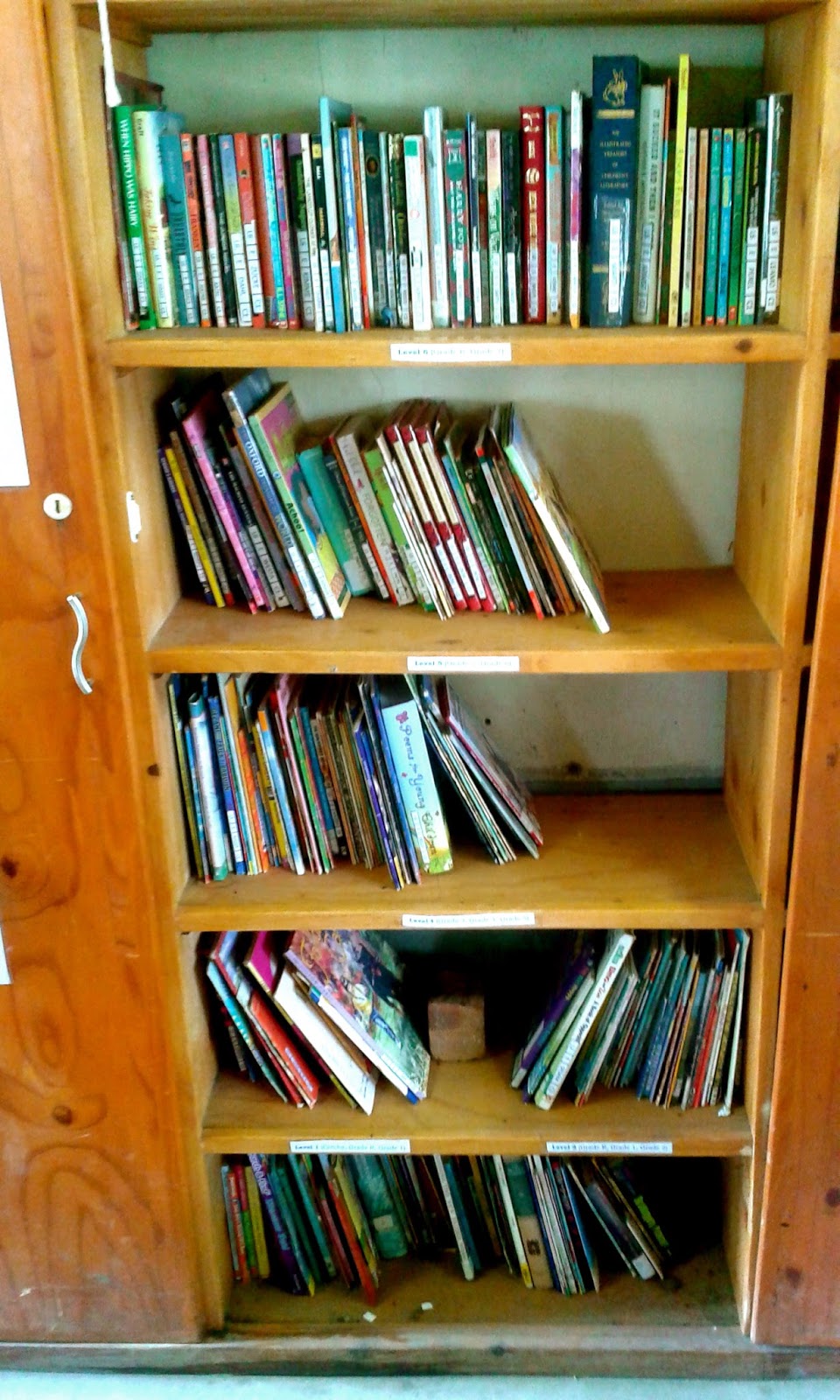
Several Books that Have Already Been Labeled in the Library at Joe's School
It takes about one hour to label roughly 60 books, if there aren’t any interruptions (i.e. learners asking a question, assisting other teachers, electricity shuts off). Luckily, there are a number of people at school who can offer a helping hand – learners and teachers!

One of Joe's Learners Cataloguing Books

A Couple of Joe's Learners Cataloguing Books

Michelle and I have been training learners and teachers how to catalogue, level, and label books. This has helped speed up the process. This has also helped teachers to see all of the fabulous resources we have and gain an appreciation for how much work goes into setting up the library and, thus, (theoretically at least) increase the likelihood that they will use these resources and work to maintain and build appreciation for the library in the long-haul.

A Few of Joe's Colleague's Cataloguing Books

One of Joe's Colleague's Cataloguing Books

As of January 2016, approximately 500 books have been labeled at each of our schools.

Now that teachers are back in the classroom fulltime because of the start of the new school year, we don’t have as many helping hands as we did, so the labeling has slowed down. It’s a good thing we have a few more months until our time with the Peace Corps comes to an end. Only about 1800 more books to go!

The Number of Labeled Books on the Shelves is Growing!

Monday, January 25, 2016

Mama Maseko: My South African Hero

There are times in your life when you meet someone who brings you such faith and hope for humanity, the giddy joys of possibility, and the inspiration to do more. In my South African life, that woman is Ma’am (or often, Mama) Maseko.
Ma'am Maseko and I at Heritage Day 2014
I first knew that Ma’am Maseko was someone special when, while making conversation with educators at my school, more than one of them cited her as their inspiration for teaching. One said, “I knew I wanted to do something good with my life, but I didn’t know where to start. Ma’am Maseko convinced me to start volunteering at the school crèche to gain experience; I loved it so much I just kept teaching.” I made a mental note to get to know this influential person better.

Over the last year and a half, I continue to be inspired by this loving, thoughtful, and passionate friend and colleague. I wanted to honour her work and our friendship by telling a bit more about her and her story with you all.

To start, I want to provide just a snapshot of her work, both at home and in the community:
  • Full-time teacher in grade R (kindergarten) at my school
  • Works 3 Saturdays each month as a trainer for Universal College Outcomes (UCO); trainees are current and future teachers through the Early Childhood Development certification program.
  • Diligently works to secure donations, sponsorship, and funding for her own community crèche.
  • Occasional Sunday school teacher
  • Occasional guest speaker at education-related events
  • Mother of two teenage girls, one of whom should be off to college this year
  • In her little remaining time, she volunteers to support and cook for family and church functions, does beadwork and other crafts (usually items for use in her classroom or in her future crèche), connecting with neighbours, reading, and listening to the radio.
Ma'am Maseko and all her grade R babies!

Mama Maseko: In Her Own Words


Michelle (Me): How old were you when you realized that you had a passion for working with children?

Maseko: In high school, I started teaching Sunday school in my church (African Evangelical Church). I would teach them songs, bible verses, and dramas so that every Sunday they could perform something for the parents during the church service. When I finished my matric (high school), I went to my nearest crèche and asked to volunteer. From 1998 they gave me a chance to work full-time with the small children.

Michelle: In your opinion, what are the most important aspects of Early Childhood Development?

Maseko: It is so important for children to go to school early to learn. A school or crèche must be suited to provide for the whole development of the child: intellectual, moral or ethical, physical, and spiritual development. We are teaching them not only the foundation for maths and languages, but also how to live their lives in a good way.

Michelle: Is that why it is your dream to open your own crèche?

Maseko: Yes. You must start when they are young to learn these things. Some people think that we are just playing in the crèche or in grade R, but even our games have a teaching purpose. The other reason why a crèche is important is to help the parents. In our area we are facing this challenge of teenage pregnancy. A 14-year old girl may be at home having a child, when she herself is also a learner in high school. As we are in a rural area, there are fewer job opportunities. So these young parents need to have an option for child care so that they can stay in school. Some of our parents are used to going to the fields and work from morning to sunset, while carrying babies on their backs. These early years are the times in the child’s life to try and help all children, especially those who are neglected due to the challenges to take care of them, by opening a place where they can be safe, secure and fed accordingly. The other reason why I want to open my own crèche is because I stay in a place where the nearest crèche is more than 3-4 km away. Most of our parents don’t have their own transportation, so if the crèche is too far, the children will not go.

Michelle: If money were no object, what would your ideal crèche look like?

Maseko: (With a huge smile) My ideal crèche would have two classrooms, one for younger children and one for the older children. It would have a kitchen area with cooking supplies and utensils, two toilets, a bathing room, and a sick bay. It would be good to have a small jungle gym outside with tires, balls, and skipping ropes for playing.

Michelle: How many learners and educators would you have?

Maseko: I think with this size it would be good to have up to 25 children. The educators must be able to teach the children well and take care of them so they are safe. When we split the children by their ages, we would need one educator for the older kids and two educators for the younger ones. We would also need a cook and a gardener or security guard. I have two educators who could come and at least 15 children already interested. The problem is that we have not been able to find or build the space. I started a crèche last year just using the carport of a neighbor’s house, but there were some issues with making the space available so we have since closed down. I still want to find some sponsorship to open a crèche permanently.

Michelle: Tell me more about the courses you teach on Saturdays.

Maseko: I work through UCO (Universal College Outcomes) to teach certification courses for Early Childhood Development (ECD). I mostly teach courses for ECD Practitioner Assistants (level 1) and ECD Practitioners seeking certification (level 4). I show them strategies for teaching the whole child through activities and play. We discuss what we must do to create a safe space for children to learn and how to encourage them to be successful. It can be difficult to get access to these courses in the rural area, so having a local facilitator is really important for training our teachers in the area. 
Ma'am Maseko, her co-teacher Ma'am Mcineka, and I dressed as learners for Hello Summer 2015

Who is Maseko to me?

Ma’am Maseko is my light and joy. Her excitement and love for her work is contagious. She and her co-teacher, Mrs. Mcineka, have created an exciting student-centered environment that is creative and resourceful. They have made caterpillars and crocodiles out of egg cartons. They have collected hundreds of bottle caps to teach counting and sorting. They have built bookshelves from found materials and empty milk cartons. They use group work and songs to teach teamwork, confidence, and language skills. In short, they are the type of educator that most educators aspire to be.

Even though she is exceptionally qualified and talented, Maseko is always eager to learn and grow. When I said I could help with computer lessons, she was the first person to show up saying, “I want to make an email address and I want to learn to type faster. But I don’t want you to do it for me, I want to learn.” When I started teaching remedial lessons, she was the first person to ask to sit in and observe a lesson.

When the children laughed at me because I mispronounced their names, she hugged me and wiped my tears. When I am excited about a new project or idea, she is the first person I want to tell. We talk excitedly about learning styles, learner confidence, and self-esteem. I taught her the word “nerd,” and now she laughs and says we are nerds together. Her friends and mentor describe her as dedicated, compassionate, a woman who truly understands the importance of our children and values her community. If I were her student, I would love coming to school every day! I love her dearly, and I thought you all should know her.
_______________________________________

Help her out:

Our Peace Corps grant options are limited when it comes to building buildings. This hurts my heart because if I would put my faith  any educator/school administrator, it would be her. She has solicited donations from local businesses but have not been able to yield the fundamental construction items. She has asked for help in identifying other grant options to which she may apply.

I would love you forever if you could research just one grant resource that might be willing to support a small, educationally focused construction project. Comment or email me with details and we will check it out!


Blogging Abroad's Boot Camp Blog Challenge: Starting January 2015

Sunday, January 24, 2016

A New School Has Begun

The new school year began last week, and, with it, some changes at school. Some of the changes relate to my direct responsibilities and others relate to observations I have made.

Firstly, how have my responsibilities changed from last school year to this school year? Last year, my main responsibility was to teach three English classes. Most of my time was occupied here. With what time I had remaining, I assisted with an assortment of assignments ranging from coaching the school’s debate team to fulfilling various requests from teachers. Basically, my focus was to teach learners English.

This school year, my focus has shifted from largely focusing on the learners to devoting more of my time to working more directly with the teachers. For example, I’m now co-teaching two English classes with two different teachers. This allows me to work with them one-on-one planning lessons, brainstorming teaching and classroom management strategies, and reflecting on how classes went. I’m also facilitating professional development workshops with the teachers. We just had one the other day about using Microsoft Excel to set up a gradebook. It was great! Aside from teaching inside and outside the classroom, I’m working on the school’s library. The library has come a long way over the last few months with the addition of several thousand books and its organization. The next steps there include training learners to be Library Helpers and utilizing the library to capitalize on school’s recent addition of a reading period to the school’s timetable*.

Since the school year has started, I have also made a few observations; some I hoped for and others I wasn’t anticipating. For example, one that I was hoping for was that the learners would be familiar to my teaching style. This translates into actively participating in class, following classroom procedures, and learners speaking at an audible volume (the learners spoke so softly when I first started in the classroom that I had a difficult time hearing them). I had heard from previous volunteers that it’s much easier teaching the second year than it is during the first. So far, this has rung true for me. Last year, it took all of Term 1 and most, if not all, of Term 2 for the learners to follow procedures. On the first day of school this year, the learners didn’t need much prodding for them to remember. After a couple of days, it was smooth sailing.

The other day, I had a confirmation of an observation I made during the previous school year regarding attention spans. In my Grade 5 class last year, the learners could concentrate with minimal distraction for about 40 minutes. Well, the teacher who’s teaching Grade 5 English this year was going to be out for the day, so I said I could cover the class. The class was going fairly well for a while, but then a few learners started talking, a learner got out of his seat without permission, and learners started asking to use the toilet. I glanced down at my watch to make note of the time and sure enough it had been about 40 minutes since the class started.

One pleasant and unexpected observation I have made so far was the ease with which the learners have understood my accent. In my Grade 7 class, I have four new learners who transferred in from other schools. I noticed they were having a hard time understanding me, so I tried asking the learner sitting next to them for help. The learner repeated what I said and the learner who couldn’t understand then got it. This was happening again and again with the new learners. At first, I didn’t understand why this was happening because my other learners could understand me just fine. And then it hit me – my accent! These new learners weren’t used to my accent. I then remembered things I did last year like clearly and crisply pronouncing each part of words and slowing down my pace. Once I did this, the learners started having an easier time. There was a cool transformation that I hadn’t realized took place with my learners last year – their ability to understand my accent – until I was with new learners.

These are some of the observations I have made at school and it’s only been two weeks. I’m curious to see how the next few months go – both with my direct responsibilities and with observations I make with the learners. I’m keeping my fingers crossed that the majority will be positive.

Here's a fun video I took of a few learners from my school having fun "sledding" while I was walking home at the end of the day.  Ahhh, to be a kid again...


_____________________________________
* timetable – class schedule

Thursday, January 14, 2016

A Day in the Life of a PCV

In 2014, we wrote about “A Day in the Life of a PCT” to share the normal training schedule for our post. Now that we have been teaching for a year, it is easy to describe a typical day in our life as full-fledged Volunteers. Here is a snap shot!
_____________________________________

5:30 am: Wake up. The sun is streaming through our copper curtains and white princess canopy/mosquito net. It is time to open my eyes and get ready for school (after a good 30 minutes reading in bed, because I am never in a rush to wake up in the morning).
Mmmm...cozy, cuddly beeedddd
6:00-7:00 am: Make my breakfast (typically cereal), feed Charlie, prepare my lunch (2 PBJ’s and fruit), get dressed (typically a cotton skirt and short sleeve top), brush my teeth, and wash my face.

7:00-7:15 am: Mental checklist… Lesson plans? Check. Textbooks? Check. Teaching aids? Check. Black bag with teacher’s file, USB, and keys? Check. Blue bag with any excess, lunch, and water for the day (filtered, of course…can’t have that runny tummy)? Check.

7:15 am: Depart for school. Ready for adventure, like Dora the Explorer!
Ready, ready!
7:17 am: Pass the cutest child that has ever existed and greet each other…repeatedly. I smell the fresh-caught fish that her mother is smoking over the fire. She will take these to sell over the weekend in the city, which is six hours away by public taxi. A high-pitched “goodbye!” echoes in my ears as I walk away.

7:18 am: Arrive at school. Greet the security guard at the gate. Sometimes I pass my bags to a group of learners who are running up to help me. Greet my colleagues.

7:30 am: The bell rings. I am embraced by the beautiful harmonies of morning prayer. You can hear a few recordings at the end of this post.
Grade 7 performing at assembly
7:45 am: Classes begin. I will teach 2 of the 6 periods that we have in the day. I use the remaining 4 hours doing any combination of the following:
  • Preparing teaching aids, seating charts, or lesson plans
  • Marking (aka grading)
  • Training and supervising the library student assistants
  • Meeting with the library committee
  • Teaching other teachers how to use the computer
  • Typing something for another teacher, for the principal, or for the library
  • Teaching remedial phonics lessons
  • Meeting with my Head of Department (HOD)
    Preparing some teaching aids
10:45 am: Lunch time! Most days I stay in the library with my ever-inspiring and entertaining learners. I have a handful of regulars who eat their lunch with me every day, tell stories, and teach others to read. Sometimes, I eat lunch in the staff room with my colleagues, where we share and share alike (as is the culture). Other days we have a staff meeting, which will likely start late and go over time (which, is also the culture).
Fabulous learners
2:30 pm: Depart school. I get kicked out by the security guard if I so much as think of staying past 2:40. I catch a ride home with a colleague, because it is futile to refuse and point out how short my walk is. Also, it is always a good few minutes of social time with friends and makes me feel included.

2:40 pm: Return home. Greet Charlie, who tries so desperately to pretend that he is calm. He sits dutifully, but the wag of his tail moves his whole body like an upright wave. I let him outside and feed him.
CHARLES!
3:00 pm: Eat an afternoon snack (typically homemade white bean dip, hummus, or popcorn).

3:20-5:00 pm: Do ANYTHING POSSIBLE to find/become/stay cool. A tin-roofed, non-insulated house can get roasty toasty! Other possible activities include: teaching mini writing lessons to the swarm of kids next door (“ngicela ungifundisa” or “I am asking you to teach me” is a common chant), marking, lesson prep, exam writing, reading, washing dishes, or writing for the blog.
Our afternoon playmates!
Stayin' cool in a homemade hammock
5:00 pm: Every few days, we must fetch our buckets of water from the taps. I typically “thwala” the water (or carry it on my head). Joe carries two buckets at a time, like they are on a yoke. Beast mode!

5:30-6:30 pm: Walk Charlie. We use any number of the small trails around our home. The paths will range between deep sand and less-deep sand with rocks. They are surrounded by tall grasses, lush gardens, and scattered fruit trees. This is our special time together where we can talk, point out the things that we see, and enjoy the sunset.
Beautiful landscape
6:30-7:30 pm: Cook and eat dinner. This is typically some form of faux Asian-peanut-sauce over pasta, pizza, or the occasional stir-fry. This meal will often be followed by one of Joe’s famous desserts.

7:30 pm: Bucket bath! On hot days, I use the unheated camp shower that Joe bought in the city. On cold days, I heat water in a kettle and do the old school bucket-and-pitcher method.

8:00 pm: Watch TV or a movie from our laptop.

9:00 pm: Read until I pass out for the night.
Lale kahle.

Thursday, December 3, 2015

Budding Libraries (Part 2): Book Donation Update

Several months ago, we shared with you that we are both working on creating libraries at our respective schools. We have made significant progress since that post and we wanted to take a moment to update you on this process and express our IMMENSE gratitude to those who made this possible.
Library Makeover: Before
Library Makeover: In Progress
Book Donations
Our schools both have between 350-400 learners. According to the Department of Basic Education in South Africa, each school of this size should have a library containing a minimum of 2,250 books in order to be considered effective. When we started at our schools last September, we had less than 100 books at each of our schools. So, acquiring books was a very good place to start!!

We both completed and were approved to receive two separate book grants for our schools:
With both Books for Africa and the African Library Project, the books are shipped from the United States to South Africa on cargo ships. It is ideal for the organisation to send shipments of books in bulk, filling one entire shipping container. The organisation, then, encourages Peace Corps Volunteers (PCVs) to collaborate in groups of 10-15 on their grants. Therefore, for both of these grants, we will talk about a “Project Lead” who is responsible for liaising with the granting organization and ensuring that us PCVs have our ducks in a row. Without these Project Leads, these grants would never have happened.

African Library Project (Grant Completed: November 2014; Books Received: October 2015)
The African Library Project (ALP) grant application is a phenomenally thorough document. It requires schools to provide everything from their library rules and consequences to policies for the use and maintenance of the books. In short, this organisation makes a concerted effort to ensure that the books donated through ALP are given to schools that have the infrastructure and sustainability to support the effective use and maintenance of the books.

With ALP, a PCV must find US counterparts who will take responsibility for hosting book and donation drives to collect the 1,000 books and $500 needed to ship and deliver the books to the school. We wanted to take a moment to honour and explain the work invested by these counterparts to make this donation possible.

For Michelle’s school, the US counterparts were a good friend, Joan, from her former church in Tacoma and her former colleague, Paul, at the University of Washington Tacoma. Tahoma Unitarian Universalist Congregation hosted a fun, family-friendly awareness event and collected donations of books or money for over a month to benefit this grant. The UWT Center for Service & Leadership hosted a month-long book donation drive and the book-packaging event, which prepared the books for shipment.
Michelle's Principal is so grateful to our African Library Project Donors!!!

For Joe’s school, the US counterparts were our dear friends, Michael and Emily, and his former colleague at Pacific Lutheran University, Tiffany.  Michael and Emily solicited friends and family for donations locally in Washington and afar in California.  At PLU, Tiffany commissioned the help of some of her student leaders in the Center for Community Engagement & Service to spread the word around the campus about the book drive as well as to set up a collection.  Once the books were collected, Michael and Emily packed them into boxes and sent them off to staging in New Orleans in order to board a ship bound for South Africa.
Joe's Shipment From African Library Project

Books for Africa & Breadline Africa (Grant Completed: October 2014; Books Received: July 2015)
When we applied for the book donation from Books for Africa (BFA), the Project Leads were two PCVs in the province of Limpopo, Pasha and Tori. Books donated through BFA are primarily books discarded by other libraries or schools. Once we were accepted, the collective group raised enough money to ship the books from the U.S. to Durban and provide overland travel to get the books from Durban to Limpopo. Once in Limpopo, a group of volunteers worked together to sort the boxes of books into piles to ensure that each school or organisation received the appropriate number of books. (These folks did a LOT of heavy lifting!)

On our side, our schools, along with two other PCVs’ schools in our shopping town, had to develop a plan to go to Limpopo, collect the books, and bring them nearly 500 miles (804.7 km) back to our villages. The PCVs and principals began this conversation in April and did a significant amount of legwork to make it possible, including: communicating with multiple district offices, calling at least a dozen moving companies, national chain grocery stores, and personal contacts. Despite our best planning and trust, the plan was not finalized until less than 48 hours before the books were supposed to be collected. As you can imagine, this caused a great deal of stress and anxiety for all of us… Let’s just say that although the “blood and sweat” part of the book delivery process was largely handled by PCVs in Limpopo, the “tears” part of the process was sufficiently met by us PCVs in KwaZulu-Natal.
Laura, on top of piles and piles of books!
On Sunday, June 7, Michelle and another volunteer from our area, Laura, got into a public taxi to start the trek to Limpopo. Thirty hours later, they met the truck driver (an employee of a friend of Laura’s principal, and our saving grace for this book collection debacle) in Polokwane and drove to collect 175 boxes, containing a total of about 7,000 books for our 4 schools. 3 days later, the truck arrived in our village and delivered the books to our schools. ((WHEW!))
Shipment from Limpopo
Donation Credits!
Our gratitude in this donation process goes first to Tori, Pasha & Caroline who coordinated the grant processes and various logistics. This would never have been possible without the donated time, energy, and finances of our two partners-in-crime, Maureen & Laura. We made it happen!! Thank you again to Michael, Emily, Joan, and Paul. You are TOTAL rock stars! Also thank you to the dozens of friends and family members who donated books and money to this cause. It has been lovely to see bits and pieces of you (children’s names in old books, labels from your local libraries, etc) from afar.

Finally, we would be remiss to overlook the dedication of our principals and library committees for their support throughout this entire process. They are the foundation for our programs and the rock upon which we stand.
Joe's learners are SO STOKED!
What’s Next:
Now, we are facing the hurdles of:

  • Sorting and labeling the books…
  • Increasing the physical space allocated to the library and, last but not least,…
  • Training learners and teachers how to use the books.

Thursday, September 17, 2015

#TBT: Reading Competition – Term 1

 *TBT stands for “Throw Back Thursday.” It is a popular hashtag on social media sites and an excuse to post old photos and things that are “throw backs” to the past.

Many of you have asked to hear more about the literacy competitions that have been happening at my (Michelle’s) school this year. So, I wanted to take you back to the beginning and highlight each one.

How it All Started
As I have mentioned here, my School Library Committee (SLC) is so amazing. You have to understand that, in my experience, the vast majority of committees created at South African schools meet only a handful of times each year, if at all. It is fairly common for a committee (or administrator, or organization, or school) to say, “Yes, we will do this thing,” and you never hear about it again. So when my SLC said that they wanted to host quarterly, internal, school literacy competitions to recognize and encourage learners to read/write/etc, I thought it was a lovely idea, but was skeptical that it would take off. I am glad that they proved me wrong.

The moment of truth came in early March when I raised my hand in a meeting and said, “I want to ask whether we are going to host a competition in Term 1. We stated last school year that we would do this every term, but we only have a few weeks left and we have not started planning. Should we skip the competition for this term and start planning for next term?” My comment was met with a resounding: NO. We must push to plan a competition for this term because if we start to slip now, we will slip the next term and the next. We can make no excuses… (Did I mention how much I love them?)

Term 1 – Prepared Storytelling/Reading and Unprepared Reading
It was decided that we would start with a basic reading competition. Students would come to the front, read a story, and be assessed on fluency. Fluency, when reading aloud, refers to the learner’s tone and inflection (do they sound natural or robotic?), pacing, pausing (at commas, periods, etc.) and ability to read with emotion.
Prepared Reading
Each grade competed in a level-appropriate way:
  • Grade R (Kindergarten): Storytelling by using pictures in a book
  • Grade 1: Storytelling by using pictures in a book (though, it was changed to sight-word recognition by the teacher)
  • Grades 2 & 3: Prepared reading (meaning, learners get to practice reading it before they present)
  • Grades 4 & 5: Unprepared reading (though, it was changed to prepared reading by the teacher)
  • Grades 6 & 7: Unprepared reading
Prepared Reading
There was a buzz of energy the entire day. This was so new, so exciting, so… different than what they had seen before. The educators were a bit hesitant at first because there were so many new things for them—a new style of rubric, unfamiliar schedule for the day, and new roles with new expectations. The committee leapt in charge of the day, though! They held judge’s meetings, purchased snacks and prizes, and even emceed, providing impromptu entertainment between participants. Despite a few hiccups (such as the slight changes in the activities for some grades), the day was a huge success!

Judges excited about a job well done!
This event was especially meaningful for me because before the event, as many PCVs will attest, I was struggling with my committee relying too much on me. They were always looking to me for the answer or waiting for me to take charge.

This competition changed something within the core of the SLC. They started to believe that they could do things on their own…and that was the greatest success of all!

Monday, June 1, 2015

Sugar Cookies & Sweet Times

Last weekend, I invited the teachers from my school over to my house to bake sugar biscuits*. Since I arrived, I have baked a variety of cookies and brought some to share with the teachers. Each time, I have been asked for the recipe. Seeing how popular the biscuits have been, I thought it would be fun to teach my colleagues how to bake one of them.

In preparation for my teachers, I made hummus and cut up some veggies. I haven’t seen hummus in the grocery store in my shopping town, so I was taking the chance that they hadn’t had it. And then I waited… and waited… and waited. In true African fashion, the teachers were running late. There was a moment when I thought they weren’t coming, but I was relieved when I got phoned* by one of them saying they were on their way.

Two of the Teachers Mixing Ingredients
Three of the teachers from my school came. They were excited and curious to see the hummus. My risk paid off; none of them had had it, and, further, none of them had even heard of it. It was fun to see them try the hummus because they commented on how healthy it was; especially to eat it with veggies.

After the hummus, I pulled out the ingredients we needed to bake the biscuits. Since the teachers were learning how to bake them, I had them mix the ingredients. It was true experiential learning in the making, evidenced by the flour on their clothes. We were having a lot of fun and we took pictures at each step. It was funny because the teachers took turns completing the same steps so they could rotate into the frame to have their picture taken. Also throughout the mixing, one of the teachers took notes so she could make the biscuits again on her own.

Cutting Out Biscuits and Preparing the Icing
With the dough prepared, I had them smell it so they could take in the vanilla aroma. They were sheepish about doing so because in Zulu culture it’s considered rude to smell food. I could see their reluctance to smell the dough, but I told them that it was okay. I explained that in American culture it’s a compliment to smell one’s food. It was a great moment to compare cultures.

The Sweet Part of the Process - Adding Icing
I then showed them how to roll the dough and cut out the biscuits. Michelle and I don’t have cookie cutters, so we improvised using a cup. (Last Christmas, Michelle and I made cookie cutters out of pop cans. Thank you Google!) The biscuits were ready to go into the oven. The teachers were surprised to see how simple it was to make the biscuits. Anytime I had brought them to school, they imagined that I went through some complex process to make them.
 
The Icing with Fun, Bright Colors!
While the biscuits baked, I heard them say several times about how they learned how to make “American cookies”. (While we mixed the ingredients, I kept switching between cookies and biscuits without realizing it and they picked up on it). I told them about how my family makes these biscuits, and many other kinds, during the Christmas season. It was how I learned how to bake. The teachers and I talked about how we were kind of like a family then since we were now making the biscuits. It was really cute.

After the biscuits came out of the oven and had a chance to cool, I showed the teachers how to make icing*. I explained to them that the frosting recipe is the same one my grandma used. I had food coloring, so I asked them what colors they wanted to make for the biscuits. They didn’t understand why we would change the color of the icing at first, but, when they saw the various colors, they commented about how the biscuits looked so much more appealing and fun. They said the biscuits kind of looked like toys because the colors made them so bright.

A Rainbow of Color
Icing the biscuits went by in a flash. We took more pictures while we decorated them. After the biscuits were iced, we each grabbed one and toasted to our success. The biscuits were so delicious! There were lots of “mmm’s” as we enjoyed a few of them. One of the teachers said that she was glad we had the hummus and veggies to start because it helped offset the biscuits we ate – haha!

Before the teachers left to go home, we took a group photo and talked about how much fun we had. They said we should hang out again and learn how to bake other things. I told them it was a date.

The Master Chefs Beaming after Their Work Was Finished
I want to give a shout out to my mom for teaching me how to bake. Every time I do, it reminds me of home and family. Last weekend, our family grew a little in size.

_____________________________
* biscuits – Cookies are known as biscuits in South Africa.

* phoned – South Africans say “phoned” instead of “called”. They make a distinction between calling someone on the phone (to phone) and calling someone from some place like across the room.

* icing – Although Americans use icing and frosting interchangeably, South Africans strictly use icing. In my family’s house, we say frosting, but, when I’ve tried using frosting here, I get only puzzled looks.

Monday, May 25, 2015

Field Trips (Joe’s School)

Preface
I live in a place where the culture views time fluidly, most people rely on walking to get anywhere, and the majority of the population handwash their clothing, bathe in a bucket, and use pit latrines because they don’t have indoor plumbing.

Field Trips
Field trips are a really big deal at my school. They are a big deal because they take a lot of coordination to make them happen and because they are expensive. Because of the time it takes to coordinate a field and its expense, they don’t happen often. (The last time my school had a field trip was in 2013.)

During the last two Saturday’s, my school participated in what they called “friendly competitions”. A friendly competition consists of a debate, soccer games, and netball* games. The first Saturday, my school travelled to another school, and the second Saturday my school was the host. As one of the English teachers, and moreso because English is my home language*, I was nominated to coach the debate team, which meant that I was also present at both friendly competitions.
The Debate Team and Joe
Weeks leading up to the first friendly competition, the teachers talked about it at just about every morning assembly*. As I listened to them, it kind of sounded like they were making a sales pitch. I could see why on the morning of the first friendly competition; the one where we travelled. Organizing a friendly competition took a lot of coordination. First, there was identifying a school and setting a date and the events; then there was booking the transportation, which in our case meant going down to the local taxi rank and hiring khumbis* to serve as drivers; and then there was getting all of the learners to the other school, fed, and back home. 
Khumbis!
The friendly competition took the entire day. At first, I was flabbergasted by how much time it took because Saturday’s are usually my day to go on a long run, wash clothes, and buy food in town. My initial feeling was that I lost that time. But then I took a moment to reflect on everything it took for the friendly competition to actually happen. There were so many moving parts: teachers, learners, khumbis, food, and more.

Reflecting back on my time as a teacher in Baltimore and, more recently, when I was a resident director at Pacific Lutheran University, I coordinated a few field trips. At both places, I don’t remember field trips requiring so much effort. Sure, there were a lot of similar logistics. However, the coordination seemed to happen more quickly in the US. But the more I thought about it, the more I realized the mechanisms to coordinate a field trip aren’t as readily available here.

Seeing how much coordination it took to make the friendly competition happen made me realize why it was scheduled for the whole day. The educators wanted to make the most of the day by having the learners participate in multiple events. Back in the US, schools will have a few field trips or multiple friendly competitions (i.e. games) per year; whereas, field trips here happen so infrequently that they are a very special occasion.
Learners Playing Netball
Afterword
My incredulity faded away when the friendly competition got underway because I could see the learners really enjoyed themselves. They had the opportunity to interact with learners from another school, show off their skills during the debate and soccer and netball matches, and dance to the house music booming from one of the tricked out khumbis. It was a day well spent.
The Soccer Team in a Huddle
-------------------
* netball - Netball is similar to basketball except there’s no backboard and only girls play.

* home language – Could also be called someone’s first language, mother tongue, or whatever language someone learned to speak first.

* morning assembly – My school meets every morning for about 15 minutes. The teachers use this time to more-or-less talk about a moral or value and how it manifests in everyday life. Examples include loving everyone like your brother or sister or respecting every elder like a parent.

* khumbi – A taxi van.